Our language has been sleeping for a long time. We are in the process of waking it up, working carefully with Elders, Knowledge Holders, linguists, and other experts to find the voices of our Ancestors once again.
Colonisation meant that our Ancestors had to stop speaking our language, to keep us safe. While some words and songs have remained with families over the generations, many of these were lost. In order to find language again, we need to look at the records made by the colonists, when our Ancestors shared our words with them.
HIDING IN THE WRITINGS OF COLONISTS
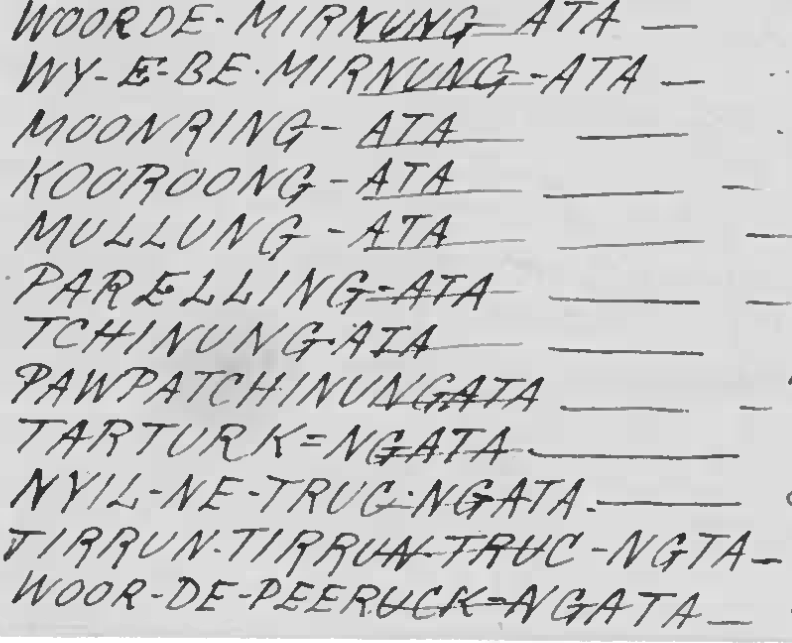
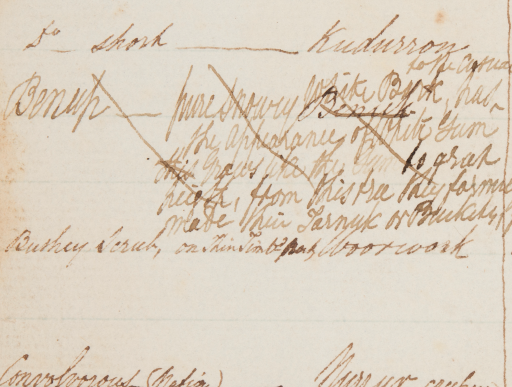
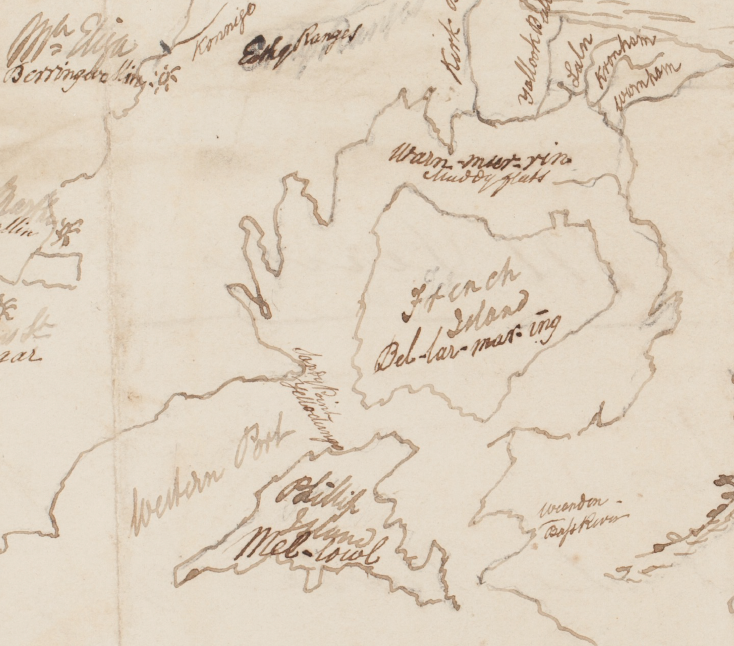
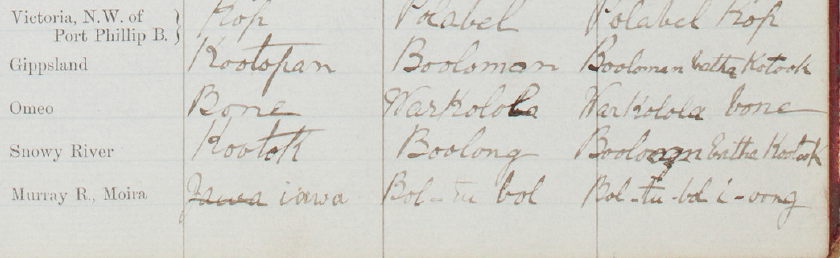
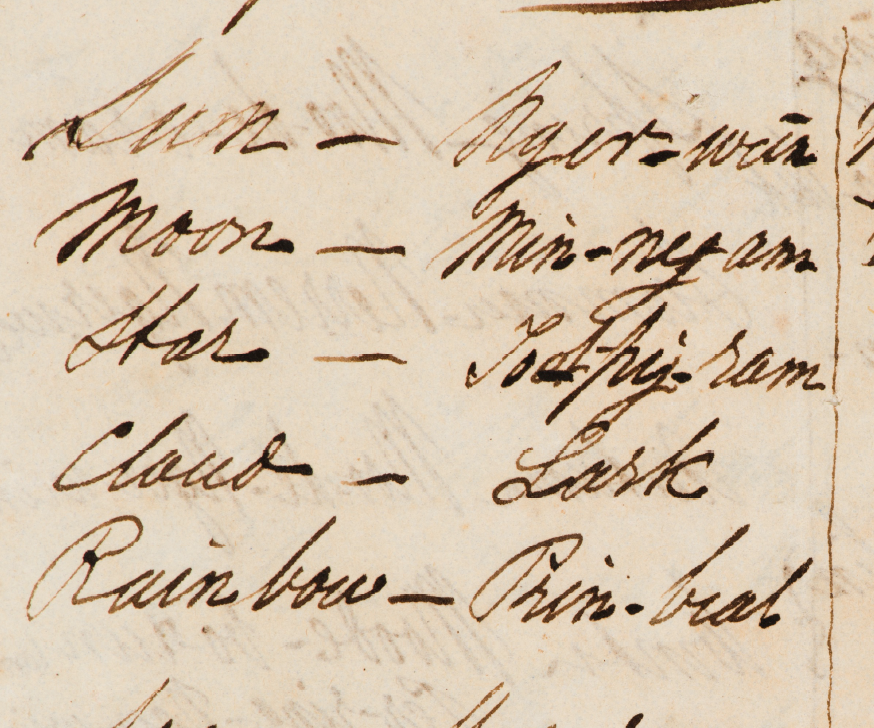
This 19th century material is very hard to use, for a variety of reasons:
Access: It can be hard to find or get copies of the material.
Bunurong language material has been found not only in Australia, but also as far away as South Africa!
Handwriting: It can be hard to read what the colonists have recorded.
Determining the language: It can also be hard to tell which language a word is from.
Something might be labelled as ‘Bunurong’, but actually be a different language.
Pronunciation and spelling: How do we know how a word should be pronounced based on the spelling?
Most of the colonists only spoke English, so all of their recordings are really English-ified Bunurong.
An example:
The word for ‘sun’ has been spelled all of the following ways by the colonists. Would you pronounce all of these the same? How do you know which one to pick?
nay-win
ner-wein
neer-win
na-ween
ngoiin
ngyen
nawin
nyawain
nerwin
noweenth
nguianda
These are all different spellings of the same word. It’s not that one of these is ‘right’ and the rest are ‘wrong’ – rather, they’re all approximations of the same word, the ‘true’ Bunurong word.
We need to be able to interpret these different spellings to find out the pronunciation the Ancestors might have used. This is where working together with linguists is particularly helpful.
WHERE DO OUR WORDS COME FROM?
For our language work, we rely on primary sources from the 1800s and early 1900s as much as possible. We avoid using later resources as these often have mistakes.
Which specific sources are we using?
The primary materials we are using are:
Daniel Bunce, Language of the Aborigines of the Colony of Victoria and other Australian Districts (1859); Australasiatic Reminiscences of Twenty-Three Years Wanderings in Tasmania and the Australias (1857), various loose handwritten language materials.
Edward Curr, The Australian race (1887).
John Green, various materials included in Smyth The Aborigines of Victoria (1878).
George Henry Haydon, Five years experience in Australia Felix (1846) and his article Australian native language in Notes and Queries (1888).
Luise Hercus, Victorian Languages: A Late Survey (1986).
Alfred William Howitt, Native Tribes of South East Australia (1904), various manuscripts from the State Library of Victoria and Museum of Victoria.
George Langhorne, various manuscripts and word lists in the William Thomas papers from the State Library of New South Wales.
John Mathew, Eaglehawk and Crow (1899).
Robert Hamilton Mathews, various published papers in the Journal and Proceedings of the Royal Society of New South Wales, several manuscripts and off-prints of these papers with annotations.
George Gordon McCrae, “Vocabulary of the Western Port Aborigines” in Victorian Historical Magazine (1917); various letters and hand-written manuscripts from the Bleek Collection at the University of Cape Town; Journal of reminiscences and poetry from the State Library of Victoria McCrae family collection.
Aboriginal Vocabulary comprising the Ballaarat, Bacchus Marsh, Melbourne and Gipps Land Dialects with a Selection of Dialogues and Familiar Phrases, erroneously attributed to William Thomas, from the Royal Anthropological Institute in London.
George Augustus Robinson, journals, vocabularies, and miscellaneous papers at the State Library of New South Wales.
Robert Brough Smyth, The Aborigines of Victoria (1878).
William Thomas, journals, vocabularies, and miscellaneous papers at the State Library of New South Wales.
The colonists almost never write down who they learned language from or where on Country language was shared with them. For this reason, we cannot trust that a list labelled as ‘Bunurong’ is necessarily Bunurong language.
As recently as the 1990s, people thought that Bunurong and Woiwurrung (the language of Wurundjeri Country, to the north of Bunurong Country) shared about 95% of their vocabulary. This was based primarily on the comments of people like William Thomas and by comparing words in word lists labelled ‘Bunurong’ and those labelled ‘Woiwurrung’. As a result, in the past most Bunurong language that has been used by community or given out to public organisations has been shared with Woiwurrung.
More recently, however, we have gained access to new language materials (primarily recorded by George Augustus Robinson) which show that Bunurong and Woiwurrung only share about 30% of their vocabulary. We are therefore finding that many of the words we previously thought were Bunurong are shared with Woiwurrung, and that there are also many unique Bunurong words that our ancestors may have used.
WHAT IS THE PROCESS FOR FINDING A WORD?
To account for the difficulties in finding Bunurong words, we do the following for every word we investigate:
Find as many examples of the word as possible by searching through all of the different colonist sources we have.
Using our knowledge of the sounds of Bunurong, reconstruct what we think is the most likely pronunciation.
After collecting our words and figuring out which ones are likely to be Bunurong, we reconstruct the pronunciation:
Starting with the first letter, we see variation between n, ny, and ng. We know that Bunurong has a sound ‘nh’ which is not in English, but can sometimes be heard by English speakers as an ‘n’, ‘ny’, or ‘ng’. This gives us our first sound.
We then move on to the vowel. We see ay, er, eer, a, ui and o. These seem to be likely the ‘a’ vowel in a word like ‘father’, with maybe a little bit of the ‘y’ sound carried over from the original ‘nh’ (like in ‘canyon’). This leads us to reconstruct our first syllable as nha.
All the sources agree on the next consonant – w. This gives us nhaw.
For the next vowel, we see alternation between i, ei, ee, e, and ai. Most of these sources seem to be a long ‘i’ vowel like in ‘heed’, so we reconstruct our word as nhawii.
Finally, we have alternation between n and nth. Nth seems to suggest that the ‘n’ is pronounced with your tongue between your teeth, like in the English word ‘tenth’. We know that this is a distinct sound from a regular English ‘n’ in Bunurong (as it is in most Australian languages). Additionally, we also know that across many other Australian languages pronouncing this sound tends to result in a little ‘i’-like vowel being heard immediately beforehand. This is why we sometimes see spellings like ein or ain. Both of these facts mean that it is likely the final vowel is nh, rather than a regular English n. This gives us the overall pronunciation and spelling nhawiinh.
After writing all of this up, our next step is to get this peer-reviewed. We send this to other linguists in our team. This is helpful because these linguists also work on other languages in Victoria and may have access to materials which we don’t. In this case, these other linguists were able to point out that wiinh is a word for ‘fire’ in many Victorian languages, which makes sense – the sun is a big fire, after all.
Finally, we present the final word to our community membersand Elders. People can read through the analysis and add any other thoughts, especially on whether this word aligns with what language community is already using, or any other cultural knowledge.
Only then is the word ready for us to share, to pass on to our families and wider communities. Finding each word takes about two months, and requires collaboration from many different experts, Elders, Knowledge Holders, and community members.
LIVING LANGUAGE
Once we’ve found the words and put them in our dictionary, the next step is to wake up our language again.
We are holding workshops for Bunurong peoples, young and old, to share and learn language. We are creating resources so people can teach themselves and their families. We are working with our allies on Country to name and rename places, to get language in schools and public places, to bring all peoples on Country into our language journey.
We need our allies to support us on our journey. This research is time-consuming and costly, but makes an immeasurable difference in healing and reconciliation. Joining us on our language journey is one of the most powerful ways to support Bunurong self-determination and reconciliation today.